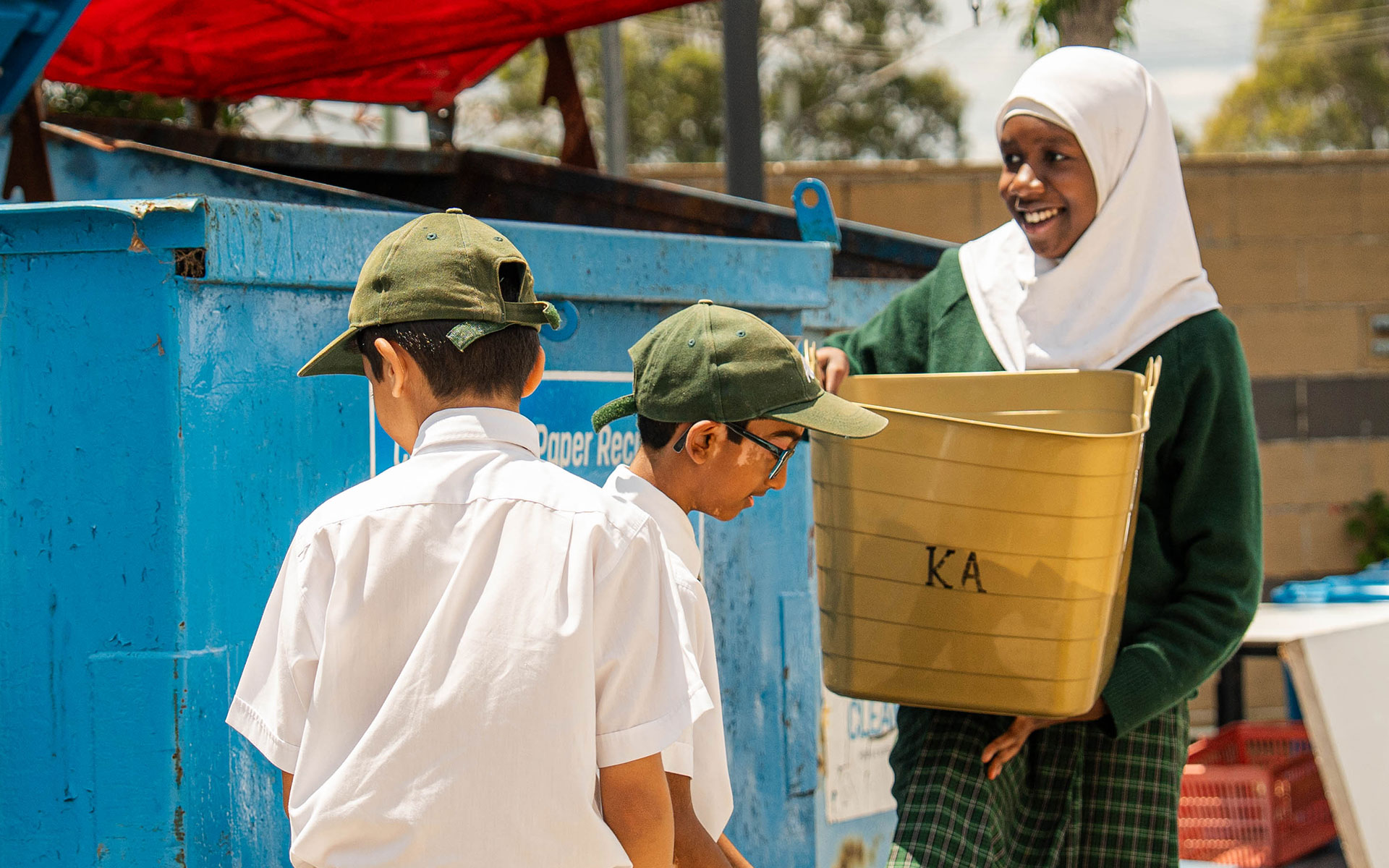
At Australian Islamic College of Sydney, education extends beyond the classroom walls. In our Secondary School, students are not only learning about sustainability — they are living it.
Through our agriculture and sustainability program, students actively cultivate gardens on campus, learning firsthand how food is grown, how ecosystems function, and how responsible stewardship shapes the future. What begins as planting seeds becomes something far greater: a lesson in responsibility, patience, collaboration and care for the environment.
Learning by Doing
Research consistently shows that hands-on agricultural education strengthens critical thinking, problem-solving and scientific understanding. When students engage directly with soil health, irrigation systems, composting and plant life cycles, abstract classroom concepts in biology, chemistry and environmental science become tangible and meaningful.
At AICS, these lessons are intentionally integrated into our Secondary curriculum. Students explore sustainability through practical gardening, water management and seasonal planting projects. They analyse growth patterns, reflect on environmental impact and develop an understanding of how global food systems connect to local responsibility.
But beyond academic enrichment, the garden becomes a space of reflection, teamwork and leadership.
Stewardship as a Faith Principle
For us, sustainability is not only a scientific concept — it is a moral one.
Islam teaches the principle of khalifah (stewardship), the responsibility to care for the Earth as trustees of Allah’s creation. Our agriculture program brings this principle to life. Students learn that environmental care is an expression of faith, gratitude and accountability.
When students water plants, tend soil and harvest produce, they are practising patience (sabr), responsibility (amanah) and compassion for creation. They begin to see sustainability not as a trend, but as a lived value embedded in daily action.
This alignment between faith and learning makes the experience uniquely AICS.
Building Character Through Cultivation
There is something powerful about watching something grow because of your own effort.
Students quickly learn that crops cannot be rushed. They require consistency, care and resilience — qualities that mirror the character traits we seek to nurture in our learners. Agriculture teaches delayed gratification, teamwork and problem-solving when conditions change.
Studies have shown that school-based gardening programs improve student wellbeing, reduce stress and increase engagement with learning. At AICS, we see this daily. The garden becomes a calm and purposeful environment where students collaborate, take initiative and experience the satisfaction of tangible outcomes.
It is also a space where leadership naturally emerges — older students mentoring younger peers, teams organising planting schedules, and students taking pride in maintaining shared spaces.
Preparing Future-Ready Citizens
In an era of climate awareness and global environmental challenges, sustainability literacy is essential. By embedding agricultural education into Secondary learning, AICS prepares students to think critically about resource management, ethical consumption and environmental responsibility.
These experiences complement our broader STEM focus and align with our commitment to preparing students for a rapidly evolving world — including the opportunities that will be expanded further with our new state-of-the-art Secondary campus launching in 2026.
Our aim is not only to educate academically capable students, but to develop thoughtful, responsible citizens who understand their impact on the world around them.
More Than a Garden
What may look like a school garden is, in reality, a living classroom.
It is where science meets faith, where leadership grows alongside vegetables, and where students learn that small, consistent actions can produce meaningful change.
At AICS, sustainability is not an add-on. It is part of who we are — nurturing knowledge, character and stewardship for generations to come.